Three theories explaining the possible causes of the untimely
ghostification of K**** and other phantom members of the class of 2006:
1) The Note-to-Float Model: This content-based theory, first proposed
by Blahblah and Boring (1532), states that the content of notes may be
toxic, and repeated prolonged exposure may result in feelings of
weightless floating and spirit-type non-being.
2) The Study Sickness Theory: This theory, propounded by Yawn et al
(1860), is process-based. Similar to the Sleeping Sickness caused by
the Tse-Tse Fly, this condition is caused by the equally deadly Paper
Five, which induces a deep sleep in the reader. Although this condition
is not permanent, it occurs every time the paper is taken up, thus
contributing to confused cognitions regarding the reality of one's own
existence.
3) Type Zzzz Personality: This trait approach suggests that Type Zzzz
Personality persons and xeroxes are incompatible and contact may result
in a sudden state of REM, and thus to instant ghostification.
Short term interventions for the spirit state include sleeping, staring
into space, chatting with friends, complaining about how pointless it
all seems, and watching T.V. However, these have been found to have
only temporary positive effects.
(Reproduced without the permission of my comrade Caroline D'Souza - a budding psychotic psychologist)
Saturday, March 25, 2006


Thursday, March 23, 2006
Patented Puking Pastilles
An erudite monograph on modes of lowering the suicide rate among stressed students
(Coming Soon at a Chemist near you)
(Coming Soon at a Chemist near you)
Monday, March 13, 2006
Airborne to Chairborne
"Airborne to Chairborne" is the title of the essay I studied in school as a 10th standard student.
Later, I met the man. His ideas on God, euthanasia and the condition of the disabled induced a catechism of my very complacent notions.
This post (his article) is a tribute of sorts !!
Airborne to Chairborne
All my attempts to move my limbs were futile. The pain in the neck was excruciating and it intensified by the second. I was stumped for a moment but quickly recovered to realise the seriousness and significance of my inability to get up. I do not remember whether I screamed involuntarily, then, in sheer desperation. On that abominable night, my mind was in a medley of intense frustration, utmost dejection and extreme disappointment. For some timeless moments, I wished I were dead.
On 28 June '88, at around 2300 hrs, whilst returning to the Officers Mess on my motorcycle after night flying, I drove onto a road barrier just ahead of the technical area gate, inside Air Force Station, Pathankot. The impact of the helmet on the wooden bar wrenched my neck and broke the cervical spine. Fifteen minutes after the accident, I was taken to the Station Sick Quarters in an unconscious state. While being carried, my head was left unsupported. The base of the helmet (rear side) which was resting against the nape of the neck pushed the fractured vertebrae into the cervical spinal cord. (The casualty must always be carried in a stretcher, after immobilising his/her neck with a cervical collar.) The resultant spinal injury completely paralysed me below the neck.
After overnight's stay in Military Hospital (MH), Pathankot, I was transferred to Army Hospital, Delhi (AHDC). Neck surgery failed to mitigate my predicament. Though I had brief spells of consciousness during the fortnight's hospitalisation in AHDC, my memory fails to recollect my fight for survival. On 12 July '88, I was transferred to the Spinal Cord Injury Centre of MH Kirkee, Pune.
Two weeks after my admission, I gathered my wits and eagerly inquired about the prognosis. The medical officer looked up and motioned his hands skywards; perhaps he wanted me to adjure divine intervention. This charade instantly deflated my hopes but it lucidly conveyed the enormity and helplessness of the incurable nature of the incapacitation. Inconsistencies of life have always bemused me but not even the wildest nightmare presaged that one day I would fall prey to such a quirk of fate. The modicum of faith I had in Providence got shattered when I failed to show even an iota of improvement.
The cervical spinal injury (quadriplegia) necessitated me to lead a totally dependent life, tethered to the bed and wheel chair. Now, I am like a man fettered for life; unable to use my hands and legs, incontinent and spoon‑fed. Ironically, the most painful aspect of quadriplegia is the painlessness! It isn’t mere loss of tactile inputs and outputs but absolute dependence on someone else to accomplish mundane necessities and domestic chores that yoked me; even for things like swabbing ears and swatting flies.
Disuse atrophy had set in within a couple of months and took its toll by altering the geometry of my torso and limbs. The mirror replicated the image of a human skeleton swathed in a layer of wizened skin. Two years' stay in MH Kirkee taught me how to battle the numerous encumbrances and how to conquer the bouts of depression. With a smile on my face, I managed to dissemble the pangs of the heart. The Indian Air Force (IAF) realised my uselessness and discharged me from the service on 12 April '90. The silly accident dealt coup de grace to my aspirations and terminated my fledgling career in the IAF. In August '90, at the young age of 26, I got admitted in Paraplegic Home, Park Road, Kirkee, Pune, as an inmate to begin the second phase of my life ‑ afresh.
I was born and brought up in a village by name Chirayinkil, 35 kms north of Trivandrum. At the age of nine, I entered Sainik School, Kazhakootam. A slow learner and an unobtrusive student by nature, I had excelled consistently in both academics and sports. Later on, I was found worthy enough to be adjudged as the best Air Force cadet of 65th course of National Defence Academy (NDA), Khadakwasla, Pune and as the best in aerobatics of 134th Pilots Course of Air Force Academy, Secunderabad. In Dec '84, I was commissioned into the IAF as a fighter pilot. I had 700 hours of flying experience (including 500 hours of flying in a magnificent flying machine called MiG-21) during my truncated career in the IAF.
All my efforts to rationalise personal catastrophes have always mystified and at times stupefied me. To adapt to the new challenges posed by the debility, I had to unshackle myself from the self‑imposed stupor. Therefore, in Sep '90, I decided to learn the art of writing by holding a pen in my mouth (because of dysfunctional hands). I began scribbling illegibly but was chagrined to find little progress even after 3 weeks' laborious efforts. Then, I decided to change tactic and wrote a letter to Sheela George, the person who kept on chivvying to start mouth‑writing (earlier I had paid little attention to her exhortations). My joy knew no bounds when I completed the few lines that embodied my first mouth‑written letter. Initially, I found my hard work to be a mere pie in the sky; but, 4 to 5 months' assiduous efforts resulted in attaining a readable style of writing. This modest achievement enabled me in reviving the chain of correspondence and begetting new friends.
In May 1991, I was presented with an electrically operated wheel chair, with chin controls for manoeuvring, thanks to the benevolence of the IAF. Motorised mobility, though only a poor substitute for natural one, has enlivened my lifestyle considerably.
It was Wing Commander PI Murlidharan, my former flight commander, who mooted the use of a personal computer (PC), as a writing tool. He added that it would assist me to utilise my mental faculty to the hilt. Hitherto unsuccessful attempts in procuring a keyboard (modified to suit my requirements) have somewhat emasculated my resolve. Nonetheless, my hope of acquiring a PC remains undiminished.
In the meantime, I toyed with the idea of teaching. For some untenable reasons, I kept on declining the offers by bringing one imaginary reason or another as an ad hoc excuse. Aforesaid setbacks notwithstanding, I'm very hopeful of converting the second phase of my life into something as meaningful as the one I would have had from the confines of a cockpit.
Believe it or not, every dark cloud has a silver lining. To surmount even seemingly insuperable obstacles, one has to muster the remnant faculties and shun the thought of disability and then canalise one's dormant energies purposefully and whole‑heartedly. It isn't just physical ability and average intelligence but an insatiable appetite for success and an unflagging will power that would texture the warp and woof of the fabric called human destiny. Greater the difficulty, sweeter the victory.
Sunday, March 05, 2006
Prejudice & Prejudice
The backdrop is quasi Grecian.
It is pouring cats, dogs, and elephants.
Elizabeth Bennet is drenched, and Mr. Fitzwilliam Darcy is dripping too.
He tells her he loves her. She rages and refuses him.
Soppy?
***
Lizzie is visiting Pemberley.
Michelangeloesque art is splashed across walls and ceilings.
Naked bodies. Fluttering cloaks.
Nude sculptures are caressed by electronic eyes.
Particularly the butt.
Soft porn?
***
Proud to be Prejudiced !!!
Wednesday, March 01, 2006
Monday, February 27, 2006
AbUSED
"I don't want to lose touch with you".
Right. Thank you.
You expect me to believe that?
Tears. Evaporation. NaCl.
So many pinches of salt.
Mounds.
Heaps.
Mountains.
I refuse to scale them anymore.
Right. Thank you.
You expect me to believe that?
Tears. Evaporation. NaCl.
So many pinches of salt.
Mounds.
Heaps.
Mountains.
I refuse to scale them anymore.
Friday, February 24, 2006
Beating Around the Bush
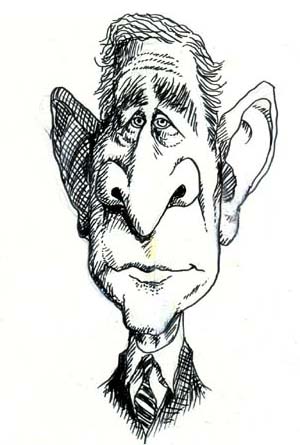
India has done a great job as a democracy: Bush
At the best of times, meeting the most powerful man on the planet can be intimidating. But when he walks into the Roosevelt Room of the White House quite unexpectedly a few minutes ahead of the scheduled interview time holding in his hands a book you have written, and quips, "I've been reading a good book lately!" the most composed journalist can be knocked galley west. You could have felled me with a noodle. I barely managed a "Thank you, Mr President" as he put the book in from of him and settled into his chair. He was flanked to his left by National Security Advisor Stephen Hadley and to his right by Presidential spokesman Scott McClellan. Two other aides sat next to them, and with me was a journalist from the Hindi daily Dainik Bhaskar .
President Bush bantered for a while with other US wire correspondents who were seated behind us but were not allowed to ask questions.
He made a brief preliminary statement about how much he and his wife Laura Bush are looking forward to their first trip to India. He also lavished praise on Prime Minister Manmohan Singh describing him as a "very decent, honorable person with whom we established warm relations... kind person (who) at the same time represented his great country's interests very well."
President Bush then took questions:
Chidu Rajghatta : Mr. President, how and why has India come front and center to US strategic thinking now after being on the margins for so many years?
THE PRESIDENT : Well, as you know there was a history, particularly during the Cold War, that made it difficult for our countries to establish a close relationship. However, things change in the world. And as the post-Cold War thaw developed, as -- attitudes began to shift.
Secondly, the Indian economy, as a result of more transparency and openness and trade, began to change. And as the Indian economy changed, it changed the commercial relationship between the United States and India.
Thirdly, there are some common threats that make it in our interests to work together -- namely terrorism. As I said in my speech today, the United States has been attacked, but India certainly understands what it means to have suffering as a result of terrorist activities. And so there's common interests that have helped to change the relationship. And I intend to seize those interests, as does the Prime Minister, in order to foster what we've called a strategic relationship.
And in my speech today, I made it clear to the American people that this relationship is in our interests. And I described the various ways it was in our interests. It's just I think the evolution of the relationship goes to show that the world is -- changes, and it's never static. And so thank you for the question.
Q : Mr. President, if India's credentials are so good, why isn't the US backing its candidacy for the U.N. Security Council?
THE PRESIDENT : Well, let me make one other point, if you don't mind, that I should have made in my speech today, and that is that there are a lot of Indian Americans who made a tremendous contribution to our country, as well. And there are a lot of -- over the last -- as the high-tech boom helped transform our society, a lot of the brain power behind that boom have been Indian Americans, as well as Indians educated here in America. And so the American people, as well, have begun to get kind of a different perspective on the great contributions that India can not only make to our own country but can make to the world.
Our position on the United Nations Security Council has been very clear. First, we support a U.N.Security Council reform, but we think it ought to happen after other institutions within the United Nations become reformed. What I was always worried about is that we would focus on the U.N. Security Council and nothing else would happen. And so we have -- we have said to all parties concerned, I fully understand the Indian position, just like other nations, that we will take your case under consideration, but first things first.
And a classic case of the reform I'm talking about is the Human Rights Commission. It needed to be reformed. And what I was, again, worried about is that we'd miss opportunity while focusing on the U.N. Security Council.
Q : Mr. President, when do you intend to take the US.-India nuclear deal before the Congress, and before the Nuclear Supplies Group, which is part of the US obligation?
THE PRESIDENT : Yes, it is. As we speak, Nick Burns, of the State Department, is discussing this vital issue with the Indian counterparts. We are working through what has been -- as I said in the speech, a difficult issue for the Indian government, as well for the American government. To change the past, the ways of the past can be difficult at times.
I appreciate the Prime Minister's courage last July of laying out a way forward, which I support. And so first things first is to go to India and hopefully reach an agreement on separation, and then bring that agreement back and start selling it to the Congress.
It's -- but we can't bring anything back until we've agreed to the agreement. And that's what's happening now. There's a spirit of goodwill and cooperation.
It's in our country's interest, by the way, to encourage India -- and aid India in its development of a civilian nuclear power program. The American people are beginning to see high prices of energy, but so are the Indian people. And the reason why is, is that there's growing economies -- ours, India's, China's -- which is adding to global demand for energy. And demand is outstripping supply, and then what happens, you see price.
And one way to help deal with price here at home and/or with India is to develop alternative ways to power homes and businesses, as well as automobiles. I was sincere in my speech today when I said that we're dedicated to research and development to come up with alternative ways to use automobiles, and want to share that technologies with other nations, particularly a nation like India, which has got huge potential and vast room for growth.
And it's in our mutual interests -- I also made it clear that it's in our interests that the Indian economy prosper. And it's a very simple reason why.
One, a prosperous country is one that is -- particularly one that has shown its capacity to deal with a multi-ethnic and multi-religious society -- it will give India more opportunity to lead, particularly in parts of the world where people need to see how democracy can work and function in a proper way.
And secondly, the American people have got to understand a prosperous India is advantageous to our own industries. I mean, we want people buying American products, Indians want Americans buying Indian products, and that exchange of trade in a free and fair way is beneficial for workers and consumers.
And I said an amazing statistic today -- at least I thought it was -- 300 million middle-class citizens in India.
That's larger than the population of the United States. And so we shouldn't fear relations with India -- matter of fact, we ought to welcome them and work on ways to strengthen them. That's really what the purpose of the trip is.
Q : Do you consider India to be a responsible nuclear nation?
THE PRESIDENT : I do, particularly when they signed the IAEA safeguards, and they have a separation between their military and their civilian nuclear parts of their government.
Q : Mr. President, would the United States have a problem if India continued to source oil and gas from Iran?
THE PRESIDENT : I think people are going to have to buy their energy where they can get it. On the other hand, I do want to make it clear to the Indian people and the Indian government that an Iran with a nuclear weapon will destabilize the world, and that those of us who are for peace and stability must work in concert. So there's a difference between energy supply and working closely to achieve a very important objective.
And we will discuss this issue carefully with the Prime Minister. There is a consensus in the world, and that consensus is that an Iranian government that has declared its -- has said that Israel shouldn't exist, for example, and if it were to have a nuclear weapon, would be a danger to all of us. And I will continue to make that point with the Prime Minister.
Q : Why has the US not questioned A.Q. Khan, whose activities intersect proliferation and terrorism?
THE PRESIDENT : Well, we were the nation that exposed the conspiracy to deal with -- more than the conspiracy, the activities, let me rephrase that -- we were the nation that exposed the activities of sharing technologies, sensitive technologies, nuclear-related weapons-related technologies. And we, of course, want to know as much about the A.Q. Khan network as possible. But had it not been for US. intelligence, coupled with British intelligence, this network never would have been exposed. And the light of day helps understand proliferation.
Q : Mr. President, why does India have to jump through the hoops to get a civilian nuclear agreement when its energy requirements are similar to China, another big, growing economy?
THE PRESIDENT : There are the nuclear supplier group, and the IAEA -- in other words, the world has signed on to this.
We think it's in India's interest to do so, as it pertains to its civilian nuclear power industry. It will give confidence to people. It will make it easier for the United States to work with India. This will be a confidence-building measure that we don't believe is an unrealistic request. And we do realize there will be separation between the military side and the civilian side. What we're working on is the civilian side.
Q : Is the US more comfortable dealing with dictators and monarchs?
THE PRESIDENT : Do what now? Do I feel comfortable doing what?
Q : Dealing with dictators and monarchs?
THE PRESIDENT : And monarchs? Well, I mean, I've got a great relationship with Her Majesty Queen Elizabeth of Great Britain. (Laughter.) She's a lovely lady and a great figure in a country that's an important ally. And, of course, that monarchy is very supportive of a free and open and democratic system.
(Getting serious) You must take the words that I said in my second inaugural address very seriously, in that we must end tyranny in the 21st century. It's a goal that all of us can work on. India has got a unique role to play. I mean, when you really think about troubled spots, these are countries many times that are having difficulty dealing with what it means to honor minority rights and welcoming different religions within kind of a social and civil fabric.
And India has done a magnificent job of showing the world how democracy can work. And it's -- India is -- I'm confident the country will play a constructive role and can do so in a much better way many times than the United States can. I mean, after all, there are 150 [sic] Muslims living within the Indian democracy. We got a lot of Muslims in the United States, as well, which shows the world that it's -- your capable of honoring -- worshiping God as you see fit, and you can do so in a free way, and at the same time, be a productive citizen of a state.
And India can help a lot. I was very impressed by its contribution to a new democracy in the neighborhood, and that's Afghanistan. India has provided $565 million of cash, recently pledged an additional $50 million to build the Afghan National Assembly building. And that's responsible -- a responsible nation does that. And it's a -- it goes to show -- at least says to me that India understands that a democracy in our neighborhood will help yield peace, because if you study the history of the world, regions that had been in turmoil are now peaceful as a result of the evolution of democracy.
And one of the points I made in my address to the Asia Society is that there are -- there's more democracies now in the region, which will make it easier for a current Prime Minister, future Prime Minister of India to help achieve the vision that we all want, which is a peaceful world.
Q : Mr. President, in this era of free flow capital,why would -- why are there so many restrictions about inflow of talent -- human capital to the United States, who probably add wealth and knowledge?
THE PRESIDENT : I appreciate that question. I am -- you're talking about visa restrictions for highly educated citizens. I am for lifting those. I think we ought to raise the level of those who are either educated here and stay here and/or come meeting high-- with high skill levels. It's in our interest.
I've always been a proponent of that.And likewise, I would hope that India would lift its investment caps. In other words -- and part of the trip is to kind of work on ways to continue to develop this strategic relationship in a constructive way.
It's a -- you know, I said something interesting -- at least I thought it was interesting -- in the speech.
I said, for a period of time, if you're a friend of Pakistan, you couldn't deal with India, and if you're a friend of India, you couldn't deal with Pakistan.
And we have tried to change the relationships so that people recognize it's in their interest that the United States is a friend of Pakistan's, and people in Pakistan recognize it's in their interest that the United States is a friend of India's to help, if need be, reduce tensions.
Right now, the level of tensions are, relatively speaking, down. I can remember when I first came into office. You might remember there was a series of incidents that got everybody quite nervous, and we had shuttle diplomacy -- Colin Powell. And it seems to me that there is a renewed commitment to resolving problems. I thought it was very interesting that trade between the two countries has doubled, that there's, you know, new transportation hubs. That's all very positive in terms of resolving issues.
You asked me about the relationship, how it's evolved, and I mentioned to you that as time passes sometimes, and circumstances change, relationships are able to develop a new dynamic. I would hope that time and circumstantial change is enabling India and Pakistan to develop a new dynamic. It appears to be that way.
Final question.
Q : Mr. President, you're going to India, but you're not visiting the Taj Mahal...
THE PRESIDENT : I know. It means I'm going to have to
Q : Have you broken the news to the First Lady?
THE PRESIDENT : No, it means I'm going to have to come back. It's a -- I am disappointed with that. People who have seen the Taj Mahal say that it's -- pictures don't do it justice. It's one of the great magnificent sites of the world. And look, if I were the scheduler, perhaps I'd be doing things differently. But you want me doing one thing.
I'll be the President, we've got the scheduler being the scheduler. I'm going to miss a lot of the really interesting parts of your great country. I know that.
I would hope that I would be invited back sometime after this trip.
Q : You could be in trouble with the "Desperate Housewife."
THE PRESIDENT : Yes. Well, she's certainly the star of the family. She's really looking forward to going with me.
Q : Between a cricket match and a Bollywood movie, what would you like watching?
THE PRESIDENT : I'm a cricket match person.
(Laughter.) I appreciate it. As I understand it, I may have a little chance to learn something about cricket. It's a great pastime. (Laughter.)
Q : Mr. President, what is your earliest memory of India.
MR. McCLELLAN : We've got to go to the next one.
Q : What is your earliest memory of India and Indians?
THE PRESIDENT : Gandhi. It's my first memory, as I think about India. You know, a person who was so spiritual that he captured the imagination of the entire world. He's proof positive that -- throughout history there have been individuals that have had the capacity to shape thought and to influence and -- beyond border. And he did that.
Q : You watched the movie?
THE PRESIDENT : I watched that, too. But that's -- but my memory was earlier than that.
Thank you.
Q : Thank you, very much.
THE PRESIDENT : Enjoyed it.
CR: Have a great trip to India, Mr President.
http://timesofindia.indiatimes.com/articleshow/msid-1426634,curpg-1.cms
Monday, February 06, 2006
Despondency?
Dear J***** (aka Jerk),
I think you are as unChristian as they come.
You do not know what you discard. More fool you...
Grow up, will you?
Regards & etc.,
Pallavi
P.S. - Forgive my juvenile delinquency, but Father Aristotle believes in 'Katharsis'.
It's the same letter, jst worse!
cut it out!
and go to sleep
u will be fine tmrw
go go go
as will i
I will
sure
fine
i will be fine
u will be fine
we will be fine
tomorrow
tomorrow
tomorrow
tomorrow never comes
so we shall be fine
tomorrow never dies
they shall be fine
you will be fine
and I shall be fine
and tomorrow shall die today
I think you are as unChristian as they come.
You do not know what you discard. More fool you...
Grow up, will you?
Regards & etc.,
Pallavi
P.S. - Forgive my juvenile delinquency, but Father Aristotle believes in 'Katharsis'.
It's the same letter, jst worse!
cut it out!
and go to sleep
u will be fine tmrw
go go go
as will i
I will
sure
fine
i will be fine
u will be fine
we will be fine
tomorrow
tomorrow
tomorrow
tomorrow never comes
so we shall be fine
tomorrow never dies
they shall be fine
you will be fine
and I shall be fine
and tomorrow shall die today
Sunday, January 15, 2006
Paycheck

The cell phone rocks to "Smoke on the Water". The LCD of my Nokia 6610 flashes "Prachi Khandeparkar".
"Yes Ma'am..."
"I want you to coach a third year student. Bhavya is bright but needs help as she was unable to attend lectures due to ill health."
"Oh, ok. I'd be more than happy to help."
"But this would be proper tutoring so you must charge her."
"Charge her? I've never charged to teach. I wouldn't know what to charge !! "
"4000 to 5000 per month . Coach her once a week for a couple of hours."
"Ok. Fine....."
...
***
Mrs. Neeta Ramakrishnan insists I coach her daughter twice a week, and that I come over to their Mahim flat to discuss the details.
Twice a week !!! No way !!! I don't have the time !!!
Let's ask for an absurd sum !! She's bound to refuse.
***
"I will charge Rs. 10,000 for coaching her twice a week for one and a half month. She must come over to my place. Is that ok?"
"That's alright. When will you begin?"
<< Is this woman insane? >>
"13th of January. Friday the 13th. And by the way, I will need a 50 % advance. Is that ok too? "
"Fine. Do you want cash, or will a cheque do?"
"Cheque is fine."
"Right, I'll give it to you just now."
"Oh no, no. 13th will be fine."
***
Flabbergasted. Boggled. Dumbfounded. Stupefied.
Paycheck !!!
Tuesday, December 20, 2005
As I Like It
Opinion about William Shakespeare’s “As you Like It”, has often been polemic, what with some critics labeling it a ‘sentimental pastoral’, while others like G. B. Shaw contending that it is more ‘lucrative’ than ‘sentimental’. Shakespeare, Shaw tells us, ‘was forced to write popular plays to save his theatre from ruin’, and that ‘he did it (i.e. wrote these popular plays) mutinously, calling the plays “As You Like It”, and “Much Ado About Nothing”’.
William Empson’s critique is a departure from extreme polemics. He identifies as a pastoral any work that contrasts simple and complicated life, to the advantage of the former. In Empson’s view, this mode of life serves as an oblique way to criticise the class structure of society. Shakespeare’s “pastoral” adheres to this definition, though not in its entirety.
Shakespeare’s attitude to either the country or the city is not unproblematic. He cannot be accused of conventional “pastoral” oversimplification. His ambiguous outlook is presented through antagonistic juxtaposition of characters – Jaques Vs. Duke Senior, Jaques Vs. Touchstone, Audrey Vs. Phebe are but some examples of the same.
Classical poets have idealised pastoral life as possessing features of the mythical ‘Golden Age’, and ‘country life’ symbolizes an innocent alternative to ambition, disturbance and war. Here, the court, as Duke Sr. tells us, is nothing but “painted pomp” – it is “envious”, and full of sycophantic “flattery”. To cut a long story short, the country is the city’s antithesis.
If the court is corrupt, the Forest of Arden should have been Elysium. But as we step into the forest with Rosalind and Orlando, we are greeted with the negative – their precise tautology confirms Arden as a “desert place”. Also, the wind is cold, and the weather such that protection becomes preferable. If Andrew Marvell in his “The Garden” painted a picture of plenitude with lines like, “The Nectaren, and curious Peach / Into my hands themselves do reach”, Shakespeare shows us that labour is a sine qua non.
Unlike Ben Jonson, Shakespeare does not declare that “the painted partrich lyes in every field/ And, for thy messe, is willing to be kill’d”. Exploitation is acknowledged through Jaques accusing the Duke of being a greater usurper than the brother who has banished him. Humans are essentially “tyrants” and “usurpers” whether they live in the country or the city, seems to be the message that Jaques wants to convey.
Nevertheless, his moralizing is lopsided. He considers usury, exploitation and neglect of the “bankrupt” not just human, but also “natural”. The deer episode exemplifies this. In a way, he contradicts his own invective against the Duke by providing him a reason for usury – nature is no better than man, so why not exploit it? – capitalist exploitation is absolved. He considers the “careless herd” callous without realising that if they neglect the wounded deer, it is only because the herd cannot help him. Ironically though being a man, and hence being capable of aiding the deer, Jaques isn’t proactive. Pontifical verse is more than enough to quell the qualms of his conscience.
Deviating from the quintessentially romanticized picture of love and friendship that pastoral eclogues portray, “As You Like It”, does not provide a motive (it is either love/lust at first sight) for love. As one critic puts it, ‘Love is all romance and poetry in Orlando and Rosalind Love is pastoral convention carried to ridicule in Silvius and Phebe. Love is a parody in Touchstone and Audrey. Love is prose, matter-of-fact in Oliver and Celia. “As You Like It”, also questions the nature of “true love”. Rosalind and Touchstone are instrumental here.
Rosalind in her “hose and doublet” catechizes Orlando as regards love and informs him that though “men have died from time to time, and worms have eaten them, but not for love”. Touchstone parodies Orlando’s callow love-eclogues, and his love for Audrey is blatantly lecherous and debauched. To speak in capitalist terms, love comes across as a ‘mutual contract’ – an ‘investment’ with its own liabilities. Rosalind while educating Phebe crudely observes that “Sell when you can, you are not for all markets”.
What Helen Gardner calls the ‘Mozartian’ nature of the play also adds to their ideological refrain with its “Most friendship is feigning, most loving, mere folly”. This wonderfully witty play with its bold and outspoken heroine and core of optimism and romance pokes gentle fun at the game of love while praising its virtues and celebrating its triumphs.
In conjunction with love, we see Shakespeare ostensibly questioning what it means to be masculine or feminine. Orlando to Rosalind, to use a cliché, is like the candle held to the sun. Rosalind’s scintillating wit has endeared her to many feminists. Consequently, they have been able to excuse Shakespeare for his rather tawdry representations – namely, Phebe and Audrey – one a coquette, and the other a fatuous country lassie, who not unlike Mr. Morel in “Sons and Lovers”, can make no sense of Touchstone’s poetry and incisive wit. (Weird, isn’t it, that some feminists should find this double indictment of gender and class innocuous?)
Shaw locates the reason for Rosalind’s enduring popularity not in her feminine traits, but in her masculinity. He points particularly to her male attire during most of the play, and to the aggressive manner in which she makes love. Shaw calls her an “incomplete human being”, but contemporary critical verbiage would probably term her behaviour androgynous.
Shakespeare’s vocabulary throughout the play makes it quite clear that Rosalind’s comportment is unlike that of the “natural” Elizabethan female – she is masculine. And if she is successful as a character, it is masculinity that must be lauded. Shakespeare’s transvestite intellectual thus does nothing to blur the gender divide as proposed by a certain faction, but only compounds the binary with obscure misogyny. Once again, to borrow from commerce, femininity is ‘unprofitable’ !!(Nevertheless, one can excuse Shakespeare, because he was not free from discourse – patriarchal or otherwise).
Shakespeare subverts the tradition of the pastoral ‘moral eclogue’ through Corin and Touchstone. Corin’s bucolic pro-pastoral sermon that applauds the ‘dignity of labour’ is negated by Touchstone’s mercantile repartee – he points out that Corin earns his living through the “copulation of cattle”.
In the Touchstone-Corin eclogue, the tension between literal and figurative language is palpable. No wonder then that C. L. Barker feels “As You Like It” is a ‘language play’ – a play wherein there is an almost Metaphysical alliance seriousness and levity. Through adroit verbal callisthenics, Shakespeare exposes how ‘Ways of Seeing’ are negotiated by one’s perspective. Though one can’t agree completely with Touchstone, one sees that Corin is no religious figure – he is not the figure of Christ as the God Shepherd. Rather, Corin is a country capitalist.
Thus we see that Arden is no pastoral idyll. Economy is not elided - the fact that economy directs sociology is acknowledged. Nevertheless, Shakespeare does not produce a counter-pastoral. The Country-City binary is not dismantled. Though Shakespeare exposes pastoral exaggeration, he still maintains the binary. The country is not an Elysium, but nevertheless, it is ‘simple’.
All the original country characters are ‘simple’ people who delight in ‘simple’ things. Hegemony is seen at play when Corin calls himself “a true labourer” who earns what he eats. Even Adam, though city bred, is a ‘loyal’ proletarian. Orlando laments that there aren’t more like Adam in whom is seen the “constant service of the antique world”. Incongruously enough, the proletariat is never shown at its labours. So though, there is no ‘magical extraction’ of the curse of labour’ (Raymond Williams) by the simple process of the extraction of the existence of labourers, there is an elision – there are labourers, but there is no actual labour !!
Thus, we see that though Shakespeare does not fall prey to what Raymond Williams calls the myth of the conventional ‘Golden Age’, he successfully creates a new ‘Golden Age’ that is based on hierarchy. The Lord’s in his manor, and all’s well with the world !!
William Empson’s critique is a departure from extreme polemics. He identifies as a pastoral any work that contrasts simple and complicated life, to the advantage of the former. In Empson’s view, this mode of life serves as an oblique way to criticise the class structure of society. Shakespeare’s “pastoral” adheres to this definition, though not in its entirety.
Shakespeare’s attitude to either the country or the city is not unproblematic. He cannot be accused of conventional “pastoral” oversimplification. His ambiguous outlook is presented through antagonistic juxtaposition of characters – Jaques Vs. Duke Senior, Jaques Vs. Touchstone, Audrey Vs. Phebe are but some examples of the same.
Classical poets have idealised pastoral life as possessing features of the mythical ‘Golden Age’, and ‘country life’ symbolizes an innocent alternative to ambition, disturbance and war. Here, the court, as Duke Sr. tells us, is nothing but “painted pomp” – it is “envious”, and full of sycophantic “flattery”. To cut a long story short, the country is the city’s antithesis.
If the court is corrupt, the Forest of Arden should have been Elysium. But as we step into the forest with Rosalind and Orlando, we are greeted with the negative – their precise tautology confirms Arden as a “desert place”. Also, the wind is cold, and the weather such that protection becomes preferable. If Andrew Marvell in his “The Garden” painted a picture of plenitude with lines like, “The Nectaren, and curious Peach / Into my hands themselves do reach”, Shakespeare shows us that labour is a sine qua non.
Unlike Ben Jonson, Shakespeare does not declare that “the painted partrich lyes in every field/ And, for thy messe, is willing to be kill’d”. Exploitation is acknowledged through Jaques accusing the Duke of being a greater usurper than the brother who has banished him. Humans are essentially “tyrants” and “usurpers” whether they live in the country or the city, seems to be the message that Jaques wants to convey.
Nevertheless, his moralizing is lopsided. He considers usury, exploitation and neglect of the “bankrupt” not just human, but also “natural”. The deer episode exemplifies this. In a way, he contradicts his own invective against the Duke by providing him a reason for usury – nature is no better than man, so why not exploit it? – capitalist exploitation is absolved. He considers the “careless herd” callous without realising that if they neglect the wounded deer, it is only because the herd cannot help him. Ironically though being a man, and hence being capable of aiding the deer, Jaques isn’t proactive. Pontifical verse is more than enough to quell the qualms of his conscience.
Deviating from the quintessentially romanticized picture of love and friendship that pastoral eclogues portray, “As You Like It”, does not provide a motive (it is either love/lust at first sight) for love. As one critic puts it, ‘Love is all romance and poetry in Orlando and Rosalind Love is pastoral convention carried to ridicule in Silvius and Phebe. Love is a parody in Touchstone and Audrey. Love is prose, matter-of-fact in Oliver and Celia. “As You Like It”, also questions the nature of “true love”. Rosalind and Touchstone are instrumental here.
Rosalind in her “hose and doublet” catechizes Orlando as regards love and informs him that though “men have died from time to time, and worms have eaten them, but not for love”. Touchstone parodies Orlando’s callow love-eclogues, and his love for Audrey is blatantly lecherous and debauched. To speak in capitalist terms, love comes across as a ‘mutual contract’ – an ‘investment’ with its own liabilities. Rosalind while educating Phebe crudely observes that “Sell when you can, you are not for all markets”.
What Helen Gardner calls the ‘Mozartian’ nature of the play also adds to their ideological refrain with its “Most friendship is feigning, most loving, mere folly”. This wonderfully witty play with its bold and outspoken heroine and core of optimism and romance pokes gentle fun at the game of love while praising its virtues and celebrating its triumphs.
In conjunction with love, we see Shakespeare ostensibly questioning what it means to be masculine or feminine. Orlando to Rosalind, to use a cliché, is like the candle held to the sun. Rosalind’s scintillating wit has endeared her to many feminists. Consequently, they have been able to excuse Shakespeare for his rather tawdry representations – namely, Phebe and Audrey – one a coquette, and the other a fatuous country lassie, who not unlike Mr. Morel in “Sons and Lovers”, can make no sense of Touchstone’s poetry and incisive wit. (Weird, isn’t it, that some feminists should find this double indictment of gender and class innocuous?)
Shaw locates the reason for Rosalind’s enduring popularity not in her feminine traits, but in her masculinity. He points particularly to her male attire during most of the play, and to the aggressive manner in which she makes love. Shaw calls her an “incomplete human being”, but contemporary critical verbiage would probably term her behaviour androgynous.
Shakespeare’s vocabulary throughout the play makes it quite clear that Rosalind’s comportment is unlike that of the “natural” Elizabethan female – she is masculine. And if she is successful as a character, it is masculinity that must be lauded. Shakespeare’s transvestite intellectual thus does nothing to blur the gender divide as proposed by a certain faction, but only compounds the binary with obscure misogyny. Once again, to borrow from commerce, femininity is ‘unprofitable’ !!(Nevertheless, one can excuse Shakespeare, because he was not free from discourse – patriarchal or otherwise).
Shakespeare subverts the tradition of the pastoral ‘moral eclogue’ through Corin and Touchstone. Corin’s bucolic pro-pastoral sermon that applauds the ‘dignity of labour’ is negated by Touchstone’s mercantile repartee – he points out that Corin earns his living through the “copulation of cattle”.
In the Touchstone-Corin eclogue, the tension between literal and figurative language is palpable. No wonder then that C. L. Barker feels “As You Like It” is a ‘language play’ – a play wherein there is an almost Metaphysical alliance seriousness and levity. Through adroit verbal callisthenics, Shakespeare exposes how ‘Ways of Seeing’ are negotiated by one’s perspective. Though one can’t agree completely with Touchstone, one sees that Corin is no religious figure – he is not the figure of Christ as the God Shepherd. Rather, Corin is a country capitalist.
Thus we see that Arden is no pastoral idyll. Economy is not elided - the fact that economy directs sociology is acknowledged. Nevertheless, Shakespeare does not produce a counter-pastoral. The Country-City binary is not dismantled. Though Shakespeare exposes pastoral exaggeration, he still maintains the binary. The country is not an Elysium, but nevertheless, it is ‘simple’.
All the original country characters are ‘simple’ people who delight in ‘simple’ things. Hegemony is seen at play when Corin calls himself “a true labourer” who earns what he eats. Even Adam, though city bred, is a ‘loyal’ proletarian. Orlando laments that there aren’t more like Adam in whom is seen the “constant service of the antique world”. Incongruously enough, the proletariat is never shown at its labours. So though, there is no ‘magical extraction’ of the curse of labour’ (Raymond Williams) by the simple process of the extraction of the existence of labourers, there is an elision – there are labourers, but there is no actual labour !!
Thus, we see that though Shakespeare does not fall prey to what Raymond Williams calls the myth of the conventional ‘Golden Age’, he successfully creates a new ‘Golden Age’ that is based on hierarchy. The Lord’s in his manor, and all’s well with the world !!
Monday, December 19, 2005
Mumbai Local
The LCD told me that the next Churchgate Slow would make me wait for six tedious minutes. I grimaced.
Why hadn't I done my usual 20 metre sprint across the Santacruz bridge down to platform number 2 ? Why had I let the earlier local grate out without me?
HURRY UP PLEASE IT'S TIME
HURRY UP PLEASE IT'S TIME
Time yet for a hundred indecisions,
And for a hundred visions and revisions.
On the platform the hoi polloi come and go,
Talking of Cutting Chai & not Michaelangelo.
HURRY UP PLEASE IT'S TIME
Hallelujah. The train cometh.
Sleek. Very sleek. Futuristic.
This was my first encounter with the new coaches introduced by the Western Railway. All steel, its insides gleamed in the evening sun. The first class compartment had plush peach seats, more easily accessible handholds, and all the fans actually rotated.
Some juvenile graffiti decorated the walls, but it was welcome for a change. "Smita - a crudely drawn heart - Anil", made me feel a wee bit at home in these alien surroundings.
Plugging the ears with never severed electronic umbilical cords dangling from omnipresent FM Tuners/I Pods/ MP3 players/Cell phones. Reading. Applying make up. Brushing hair. Nose digging. Etcetera & etc.
To cut a long story short, all the normal "Mumbai Local" functions had ceased. We were actually looking around, and at each other.
I am told that the "Second Class" ladies generally share a great rapport, and over time form their own micro communities which discuss everything from nits to nervous disorders.
Being a part of the elite "First Class", I had barely exchanged a word with my co-passengers. 'Mind your own business' seemed to be the creed, and so I was in for a surprise. Sheepish, almost apologetic smiles were exchanged.
"This is my second time".
"This is my first".
"Cool na ?"...
...was interrupted with the unusually clear and surprisingly not nasal,
"Attention please. The next station is Khar Road. Agla station Khar Road hai. Dhanyavaad".
Deja vu! Deja vu!
The Kolkata Metro anyone? The only difference being that they didn't announce the exit direction. (By the by, why do they always have female announcers? I wouldn't mind a Bacchanesque baritone).
More smiles, and some gawking at the LCD which many (yours truly included) had not noticed initially ensued.
Smiles. Grins. Giggles. Chuckles. Chat.
Such a Long Journey ??
No. Non. Nein. Nahi.
Why hadn't I done my usual 20 metre sprint across the Santacruz bridge down to platform number 2 ? Why had I let the earlier local grate out without me?
HURRY UP PLEASE IT'S TIME
HURRY UP PLEASE IT'S TIME
Time yet for a hundred indecisions,
And for a hundred visions and revisions.
On the platform the hoi polloi come and go,
Talking of Cutting Chai & not Michaelangelo.
HURRY UP PLEASE IT'S TIME
Hallelujah. The train cometh.
Sleek. Very sleek. Futuristic.
This was my first encounter with the new coaches introduced by the Western Railway. All steel, its insides gleamed in the evening sun. The first class compartment had plush peach seats, more easily accessible handholds, and all the fans actually rotated.
Some juvenile graffiti decorated the walls, but it was welcome for a change. "Smita - a crudely drawn heart - Anil", made me feel a wee bit at home in these alien surroundings.
Plugging the ears with never severed electronic umbilical cords dangling from omnipresent FM Tuners/I Pods/ MP3 players/Cell phones. Reading. Applying make up. Brushing hair. Nose digging. Etcetera & etc.
To cut a long story short, all the normal "Mumbai Local" functions had ceased. We were actually looking around, and at each other.
I am told that the "Second Class" ladies generally share a great rapport, and over time form their own micro communities which discuss everything from nits to nervous disorders.
Being a part of the elite "First Class", I had barely exchanged a word with my co-passengers. 'Mind your own business' seemed to be the creed, and so I was in for a surprise. Sheepish, almost apologetic smiles were exchanged.
"This is my second time".
"This is my first".
"Cool na ?"...
...was interrupted with the unusually clear and surprisingly not nasal,
"Attention please. The next station is Khar Road. Agla station Khar Road hai. Dhanyavaad".
Deja vu! Deja vu!
The Kolkata Metro anyone? The only difference being that they didn't announce the exit direction. (By the by, why do they always have female announcers? I wouldn't mind a Bacchanesque baritone).
More smiles, and some gawking at the LCD which many (yours truly included) had not noticed initially ensued.
Smiles. Grins. Giggles. Chuckles. Chat.
Such a Long Journey ??
No. Non. Nein. Nahi.
Tuesday, October 11, 2005
Brown Skin, White Masks

Fair & Handsome !! A fairness cream for men with a double peptide bond for "tough male skin" !! What tough skin?? Skin is skin, is skin, is skin, ain't it?
By the by, what happened to tall, dark & handsome ??
Tuesday, September 06, 2005
New Kid on the Block !!
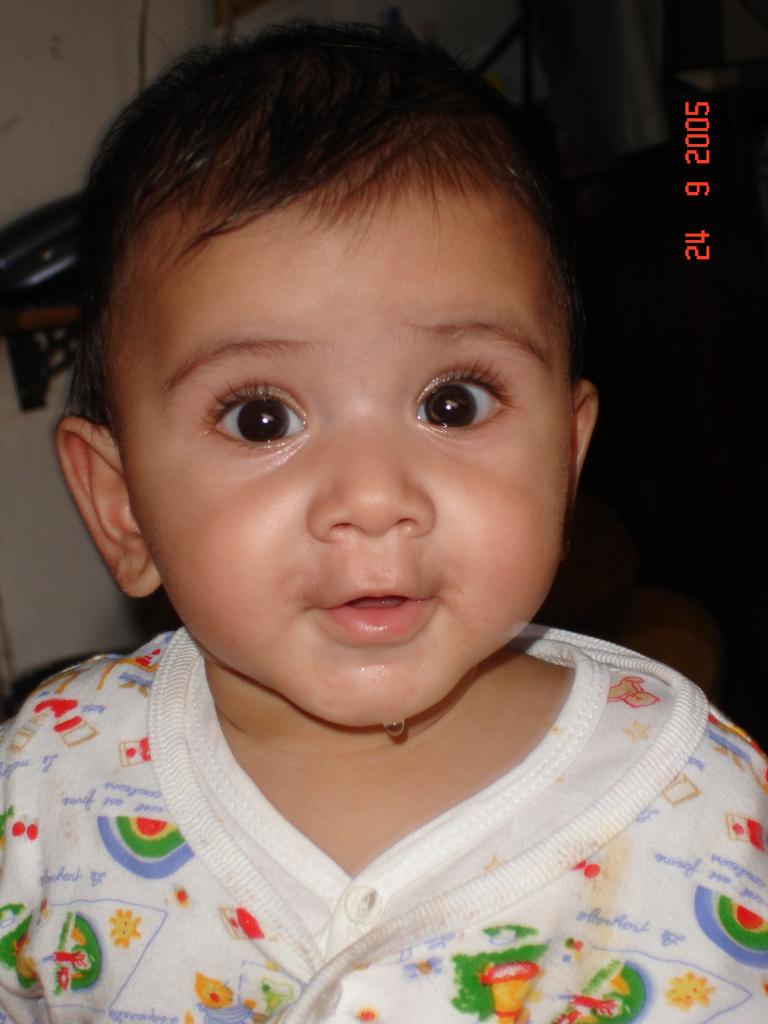
Yes, there's a new kid on the block. And no, I am not talking of Donnie, Jon, Joe, Danny or Jordan. He's all of five months, and he's my nephew !! With more nieces and nephews than I can count, I'm definitely headed for senescence. :P
Sunday, August 21, 2005
Baby's Day In

Click. Flash. Grin. Then back to crying or wailing or tugging your hair off. When a camera stares her in the face, my niece Ananya looks straight at the lens and gives you her best toothless all-gummy grin. A definite child prodigy !! Classical Conditioning anyone?
Monday, August 08, 2005
In Theory
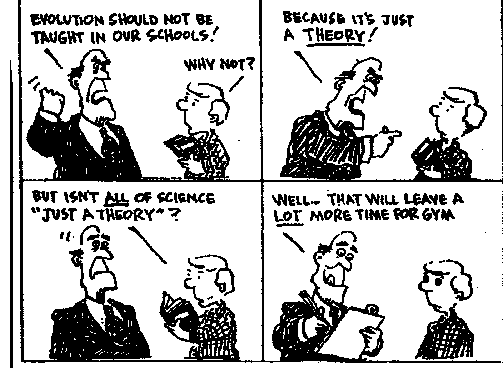
Another application of all the literary theories we canvass in class....
But before that, it is very
important that all of you attempt the following psychological test !!
No cheating. Pick your dessert, then look to see what
Psychiatrists think about you!
After taking this dessert personality test, copy,
paste and send this e-mail on to others, with your OWN application of
the various theories that you are aware of !!
If you were making a dessert and you had your choice
of those below (or some great bakery was baking the
dessert of your choice), which would you choose?
> *Angel food
> *Brownies
> *Lemon Meringue
> *Vanilla with Chocolate Icing
> *Strawberry Short Cake
> *Chocolate on Chocolate
> *Ice Cream
> *Carrot Cake
>
>
> NO ... You can't change your mind once you scroll
> down!
>
>
>
>
>
>
> So think carefully, what your choice will be!
>
>
>
>
>
>
>
>
>
> OK - Now that you've made your choice, this is what
> research says about you!
>
> Angel food...
> Sweet, loving, cuddly. You love all warm and fuzzy
> items. A little nutty at times. Sometimes you need an
> ice cream cone at the end of the day. Others perceive
> you as being childlike and immature at times.
>
> Brownies...
> You are adventurous, love new ideas, are a champion of
> underdogs and a slayer of dragons. When tempers flare
> up, you whip out your saber. You are always the
> oddball with a unique sense of humour and direction.
> You tend to be very loyal.
>
> Lemon Meringue...
> Smooth, sexy, & articulate with your hands, you are an
> excellent after-dinner speaker and a good teacher. But
> don't try to walk and chew gum at the same time. A bit
> of a diva at times, but you have many friends.
>
> Vanilla with Chocolate Icing...
> Fun-loving, sassy, humorous. Not very grounded in
> life; very indecisive and lack motivation. Everyone
> enjoys being around you, but you are a practical
> joker. Others should be cautious in making you mad.
> However, you are a friend for life.
>
> Strawberry Short Cake...
> Romantic, warm, loving. You care about other people
> and can be counted on in a pinch. You tend to melt.
> You can be overly emotional and annoying at times.
>
> Chocolate on Chocolate...
> Sexy, always ready to give and receive. Very creative,
> adventurous, ambitious, and passionate. You have a
> cold exterior but are warm on the inside. Not afraid
> to take chances. Will not settle for anything average
> in life. Love to laugh.
>
> Ice Cream...
> You like sports, whether it be baseball, football,
> basketball, or soccer. If you could, you would like to
> participate, but you enjoy watching sports. You don't
> like to give up the remote control. You tend to be
> self-centered and high maintenance.
>
>
> Carrot Cake...
> You are a very fun loving person, who likes to laugh.
> You are fun to be with. People like to hang out with
> you. You are a very warm hearted person and a little
> quirky at times. You have many loyal friends
From: Pallavi Mogre
Date: Sun Nov 30, 2003 5:10 am
Subject: I chose Brownies, BUT according to POSTCOLONIAL tenets.....
...there's a big problem with this test !!! Edward Said would probably
call it "Eurocentric" !!
I may have heard of angel food, and lemon meringues, but I have no
idea as to how they taste etc. Plus, this test OTHERISES vegetarians,
and those whose sweet tooth never erupted !!
Maybe we should invent (or should I say CONSTRUCT, because I don't
particularly believe in these tests) a psychological test with stuff
like jalebis and rasgollas ... or would that be called NATIVISM ??
Also, I can't be sure that these rasgollas were originally Indian,
right? For all I know, they may have come to India from Timbuktu. So,
HOW NATIVE IS NATIVE?
And would I be justified in making these UNIVERSALIST ASSUMPTIONS?
Some people don't even get one square meal a day.
MARXISTS would declare war on these jalebis and rasgollas, and
FEMINISTS would probably brandish statistics telling me that though
chefs at 5 star hotels may be male, the scene at home hasn't changed
all that much, and that women are still frying the jalebis !!!
Oh well.......
..........let's just enjoy our dessert, eh? ;)
Friday, July 22, 2005
Snippets

"Is that Bal Gangadhar Tilak?"
"No, it isn't. Tilak was hideous, and he most certainly isn't !"
The portrait hung in what used to be the drawing room of a palatial two storeyed colonial style bungalow. The red turban, grey moustache, and the regal customary shawl made it distinctive. What was peculiar about the portrait was that its eyes followed you regardless of which corner of the room you chose to occupy.
Bringing out the family tree, and directing my attention to its apex, my grandfather told me that this was the man who built the place I then called home. My friends told me it looked spooky by night. Maybe it did. But it was home...surrounded by gardens, a well and stables, it must have been magnificent two hundred years ago.
Gradually, the old place in the heart of Girgaum had been hedged in by towering concrete structures. A part of the garden was rented to box-makers; and the stables were converted into a dumping ground for kitchen waste, where a cat and her kittens found home every year.
***
"Don't worry beta ! Aap mujhe bas do sau rupaiye de do, aur main aap ko berth dila doonga. T. C. ko hum sambhaal lenge. Aap ghode bech ke sona."
Squirming inside the linen closet of the first class A.C. compartment of the Guwahati bound express, the strains of a soppy Hindi oldie kept reverberating through my mind. "Karvate badal te rahe aadhi raat hum" was my predicament, the only flipside being that roaches had replaced romance.
I kicked the air as yet another cockroach attempted to scale the Everest that was my shank. A small shower of sweat beads accompanied every bid to do away with affectionate insects. Streams of perspiration branched out into tributaries as they encountered epidermal cilia. Lying chained to my own luggage, the fatuous optimism with which I had boarded the train at Dadar oozed out of every pore in sauna like fashion.
Securing my suitcase to the adjacent basin pipe had proved unsuccessful. The bright red VIP Eleganza had been inadvertently splattered with frothy fluoridated sputum spewed by compulsive brush-before-going-to-bedders, some stray droplets making their way to my makeshift bunk.
The stomach churned bile. The aroma wafting from the loo added to the nausea.
***
She had more holes than a normal person does, and the reason was not genetic. She needed her nose rings, her eyebrow rings, her navel rings and of course her earrings to face the world.
Smart. Pretty. Intelligent. Arrogant. These were the epithets used when Nancy Misquita was mentioned. But she knew better. It was only in the bathroom of her plush Bandra flat that she shed her inhibitions as well as her clothes.
Devoid of props, she shuffled onto the weighing machine. The scale hand traced an almost acute arc and stood still. "Perfect", she murmurmed and then looked up to face her fogged reflection in the mirror. She didn't really need her kilograms to tell her that she was eyecandy. Catcalling roadside Romeos confirmed that almost every other day.
That was not to say that obese and ugly women were spared. But at least they called her "Sophia Lauren" and not "Moti Mausi". Where such riffraff came across Lauren she failed to fathom...
***
As the Virar fast lurched away from the Charni Road platform, a silent scream escaped Nancy. Wailing was futile. There was no one in the empty train compartment to hear her cries. No one except that cold-blooded thing, that glinted at her with unblinking eyes. And what was worse, it was advancing, and even her martial arts training could not keep it at bay.
She eyed the “In Case of Emergency Pull Chain” sign. Did she dare yank it? Wouldn’t it be awful to be stuck with this pintsized saurian between stations? And how could she face the Railway Police in case it escaped? She couldn’t jump off after pulling the chain, could she? What if a train was chugging along the adjacent track? What if…what if…
Her close encounter with it when she was all of ten years had left her traumatized. As dusk approached, she would go around shutting all windows and pulling the curtains across. For fifteen years she had followed this ritual daily. Not a chink of light could escape. It was a complete blackout…more complete than the prescribed blackouts during the Indo-China war. And after all her precautions, she was stuck in a train compartment with it !!
The train slowed down. “Mumbai Central” blurred past her watering eyes. The train stopped. How? Why? What? rushed through her frantic mind even as she alighted.
“Platform No. Do pe aaiye hui train yard jayegi. Yatriyon se vinanti hai ke we is train ko khali kare. Yatriyon ki asuvidha ke liye khed hai. The train halting at Platform No. 2 is going to the yard. Passengers are requested to please vacate the train. The inconvenience caused is deeply regretted”, blared the usually unwelcome nasal voice of the railway announcer as Nancy ascended the bridge en route to the taxi stand. No more local trains…ever !!
Nancy was convinced that she would die of a heart attack if she had to share a train compartment with a wall gecko again !!
***
Wednesday, May 11, 2005
The Famished Five
Apart from applesauce, there's plenty to be had. Where's the menus you ask.
Well, here goes: jugs of creamy farm fresh milk, homemade orangeade and lemonade, cold ginger beer, warm squishy loaves of home baked bread, jammy buns, butter, hard boiled eggs, fried eggs, omelettes, bacon, ham, tongue, pork pies, apple pies, mince pies, buttered crumpets, gooey macaroons, smashing salads, a variety of sandwiches, chocolate cakes, cherry cakes, fruit cakes, tureens of peas and potatoes, mouthwatering stews, plum pudding, date pudding, tinned pineapple, tinned peaches, tinned sardines, potted meat, potted shrimp, bars of chocolate, toffee, boiled sweets, tomatoes, potatoes, lettuce, strawberries, apples, peaches, licky ice-creams, meaty bones, dog biscuits...
...the list is sempiternal and in most cases, the eatables are alien. It is evident that Enid Blyton's gustatory modality is rather acute. Nevertheless, it would be much better if she spared us the details. Read. Chomp chomp. Chew. Crunch. Munch. Read. Munch. Munch and munch !!! It's true. I've never been able to read "The Famous Five" (or for that matter, any other Blyton book) without having something at hand to feast on.
The Five eat between their adventures. I eat between meals. They no doubt burn all the calories they consume while they climb hills, row to Kirrin Island, go fishing, cycling, hiking, skiing, camping, and of course, adventuring. I, lazing on the sofa, merely add another unwanted kilo to my weight !
Avoirdupois anyone? And no, that's not pabulum !!
Sunday, December 05, 2004
Folderol
Does that sound like medicine? Well, it is too. The best you can get. Not that I intend to post it. I only know the recipe for applesauce !!!
Subscribe to:
Posts (Atom)